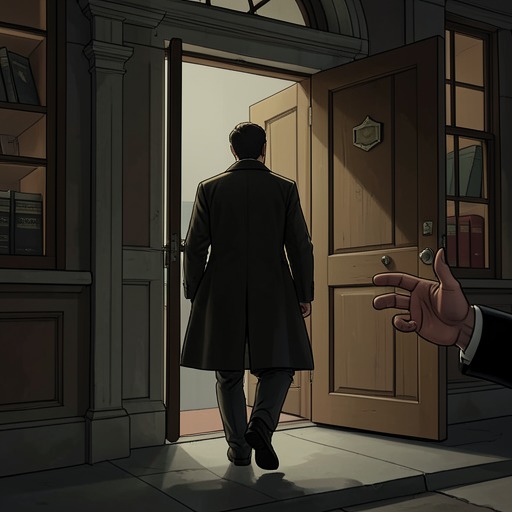
Bank robber
Anxious PeopleThe Bank robber is a mother of two whose desperate attempt to raise one month’s rent turns the logic of financial risk into a family crisis. Her life links a childhood shaped by her mother’s alcohol dependence to an adult struggle with divorce, insecure work, and the threat of losing her children. The failed holdup is not presented as an isolated criminal impulse: it grows from a narrowing set of options, even as the real pistol she takes into a cashless bank makes the danger of her decision unmistakable.
Identity and Background
The Bank robber is a woman and a parent of two daughters. As a child, she learned early that plans could collapse and that adults might ask children to bear the consequences. Her mother often drank despite saying that she did not intend to; the child responded by promising never to drink hard liquor and never to become an adult. She kept only half that promise: she grew up and became a parent, but did not start drinking hard liquor.
One childhood memory gives the story’s later concern with responsibility a personal source. Before Christmas Eve, her mother, distressed and intoxicated, clung to the child after the child had spent a month selling magazine subscriptions and handed over the earnings so there would be food for Christmas. Her mother’s apology shifted responsibility onto the child for having entrusted her with the money. It was the nearest the mother came to asking forgiveness. The Bank robber still thinks about the episode, not simply as an injury but as a reason she cannot bring herself to hate her mother or believe that it was wholly her mother’s fault.
The following February, they were evicted. The Bank robber vowed never to become a parent, and, after becoming one, vowed not to become a chaotic parent unable to manage adult responsibilities or provide a home. That history makes her later insistence on coping alone more than a matter of pride: she knows what it is like for a child to absorb an adult’s instability, and she is determined not to pass that experience to her daughters.
Divorce, Housing, and Scarcity
After her marriage broke down, the daughters and their other parent remained in the apartment, which was in the other parent’s name. The Bank robber did not want to make a scene or turn the separation into a fight. Her former husband and the person who had been her boss became a household together, while she was left without a home of her own. The loss carried more than the immediate displacement: she had not expected to lose her family life and future plans in the space of an afternoon.
Finding somewhere to live proved difficult without savings or a job. Buying was out of reach, while renting required a deposit of four months’ rent. The Bank robber eventually found a small sublet close to where her daughters lived, near the bridge, but it cost 6,500 kronor a month. The arrangement was itself precarious, since the person renting to her was already subletting from someone else. She emptied her account and sold her possessions to cover one month, then spent that month worrying about how to afford the next.
Work offered no quick escape. She found a job, but it paid too little to make her secure, and her first month’s wages would be withheld until she had worked for two months. When she asked the bank for a loan to bridge the gap, it refused because her job was not permanent. The reasoning left her trapped: she needed money to keep working, but the bank would not lend to someone whose lack of money made her need a loan.
The legal pressure over custody sharpened that trap. A lawyer representing her former husband argued that the children’s situation was untenable because their other parent had neither a home nor a job. The Bank robber avoided asking the welfare authorities for help, afraid that intervention might separate her from the girls; memories of protecting her own mother from scrutiny shaped that fear. She accepted the divorce and did not contest the apartment or job, hoping to spare the daughters a war between their parents. When she later received another threatening letter from the lawyer and a notice from her landlord that she would be evicted if she did not pay, the need for rent became inseparable from the fear of losing her children.
Motherhood and the Daughters
The Bank robber’s daughters are presented as unusually considerate of one another. The younger sister is allowed into the older sister’s room without being shouted at, and the older sister’s treasured possessions are safe from deliberate damage. When they were small, their parents privately recognized how fortunate they were to have them. After the divorce, the girls moved between their parents’ homes. During the weeks with the Bank robber, they rode the bus and invented stories about the strangers around them, sharing the game with their parent and laughing together.
The children’s affection also appears in a small act that becomes significant when the Bank robber leaves home to commit the robbery. The younger daughter has drawn The drawing of a monkey, a frog, and an elk and secretly put it in her parent’s pocket. The Bank robber does not know it is there. The drawing travels with her into a decision that her daughters cannot yet understand: while they listen to the news in the car during their weeks with their other parent, they do not know that one of their parents has become a bank robber. The contrast between the child’s private gift and the public news of the crime makes the family bond present even when the daughters are absent from the crisis.
The Failed Holdup
On the day before New Year’s Eve, with rent due and the custody threat pressing on her, the Bank robber decides to seek 6,500 kronor from a bank. She tells herself she needs only enough for one month, that she will return the money when she is paid, and that a single chance will allow her to put things right. The plan has no workable answer to what happens after the money is taken; its urgency has narrowed her attention to the immediate deadline.
She makes holes in a black woolly hat and pulls it over her face, then enters a bank with a pistol she believes to be a toy. The bank contains no cash: it is a cashless bank, so the intended robbery fails at the most basic level. The irony is pointed. The institution will not lend her money because she has none, yet the bank she chooses to rob has no money for her to take. Later, it becomes clear that the pistol was real, not a toy. That discovery transforms what she had treated as a desperate, limited attempt to secure rent into a much more dangerous crisis.
Moral Hazard and Narrative Significance
The Bank robber’s circumstances are placed alongside those of the man on the bridge, whose financial collapse began when supposedly secure investments and borrowing turned into debt. The two never met and are not otherwise connected; the parallel is the unequal distribution of risk. The man was told that he had suffered moral hazard when a bank protected itself from the consequences of its actions while leaving him with the losses. The Bank robber never had enough money to hear that explanation from a bank, but her childhood had already given her an intimate version of the same idea: her mother made the child feel responsible for money the adult had misused.
That parallel does not make the Bank robber’s choice harmless or erase her agency. Instead, it shows how the story places individual responsibility beside systems that restrict a person’s available choices. Housing is treated as something guarded by savings, deposits, creditworthiness, and employment status, while for the Bank robber it is the condition she believes she must secure to remain a parent in her children’s lives. Her attempt to obtain rent money by force is the culmination of that collision, not a solution to it.
The character’s decisive significance lies in this double perspective. The Bank robber commits a crime with a real weapon, but the narrative also traces the pressures that made a month’s rent seem like the last remaining barrier between her and losing her family. Her childhood promise not to become a chaotic parent collides with a society in which work may not provide immediate wages, a bank will not lend to someone without money, and a home may depend on deposits she cannot assemble. The story neither reduces her to the crime nor treats desperation as an excuse; it makes both the choice and the conditions surrounding it impossible to ignore.